- 877-942-5613
- information@connectservicesolutions.com
- 44 Grant 65, Sheridan, AR 72150
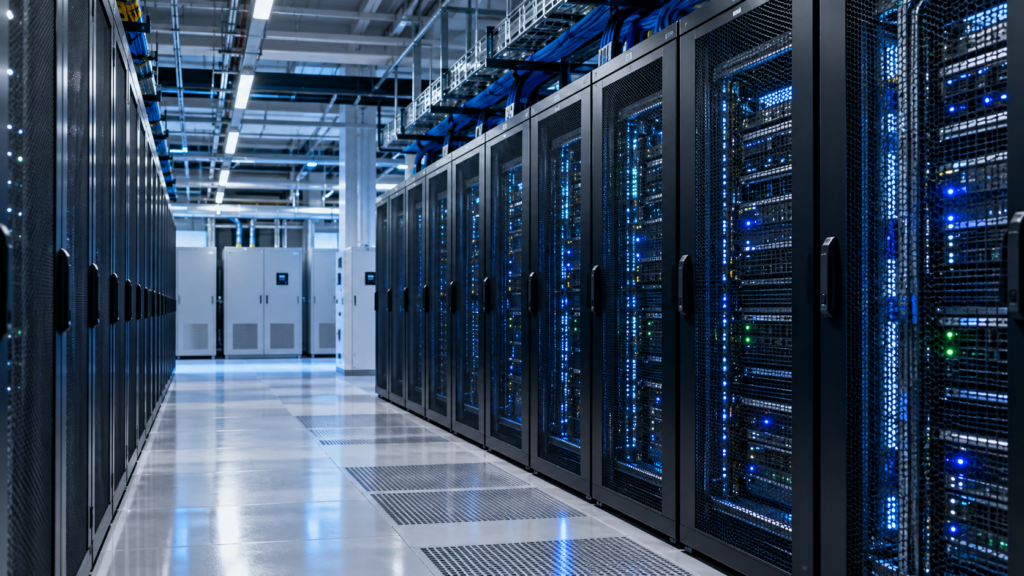
If you are laying the groundwork for a new data center—or planning upgrades to an existing facility—the design assumptions from even a few years ago may no longer reflect today’s operating environment.
Rack densities are climbing. Cooling requirements are changing. Power availability is becoming a critical site-selection and capacity-planning consideration. And as AI and other high-performance computing applications accelerate demand, facility infrastructure is being asked to support significantly more load within the same—or sometimes smaller—footprint.
For owners, developers, and facility teams, that means load and energy assumptions need to be addressed earlier in the planning process.
Here is what current industry reporting through 2026 tells us about rack density, cooling requirements, and power availability—and what those numbers could mean for facility planning.
Data center planning has always started with a load number. What has changed is how quickly that number is moving.
According to figures reported in the AFCOM State of the Data Center Report 2026, average rack density has increased significantly in recent years:
| Year | Average kW per Rack | Change |
|---|---|---|
| 2021 | 7 kW | Baseline |
| 2023 | 8.5 kW | Gradual |
| 2024 | 12 kW | Accelerating |
| 2025 | 16 kW | Accelerating |
| 2026 | 27 kW | Up approximately 69% in one year |
Source: AFCOM, State of the Data Center Report 2026. Figures represent blended industry averages and may vary significantly by facility type and workload.
The reported average rack density increased from 16 kW in 2025 to 27 kW in 2026. Compared with the 7 kW figure reported in 2021, that represents a dramatic change in only five years.
That matters because data centers are rarely designed for a single year of operation.
A facility planned around today’s average may be expected to support tomorrow’s higher-density workloads. Mechanical, electrical, structural, and other facility systems therefore need to account not only for what is being installed today, but also for how the facility may evolve.
The question becomes less about “What is our current load?” and more about “What load should this facility be prepared to support over its useful life?”
Industry averages can also hide an important distinction.
Traditional enterprise and colocation environments may operate at relatively modest rack densities, while AI and high-performance computing environments can require dramatically higher capacities.
That creates a widening gap between conventional data center infrastructure and purpose-built high-density environments.
For facility planning, the takeaway is straightforward: an average rack-density number is only useful when you understand what type of facility and workload it represents.
Teams should distinguish between:
Current installed rack density
Average operating density
Maximum design capacity
Expected future density
High-density or AI-specific zones
Those numbers should not be treated as interchangeable.
As rack density increases, heat removal becomes one of the defining infrastructure challenges.
Conventional air cooling remains appropriate for many data center applications. However, published industry analysis generally places practical limitations on traditional air-cooling approaches as rack densities move into higher ranges.
That means the cooling conversation can no longer wait until late in the design process.
Higher-density environments may require a combination of strategies, including:
Optimized airflow management
Hot-aisle or cold-aisle containment
Higher-capacity mechanical systems
Direct-to-chip liquid cooling
Rear-door heat exchangers
Hybrid air-and-liquid cooling configurations
Many facilities may ultimately operate with a combination of technologies—maintaining traditional air cooling in lower-density areas while introducing liquid cooling infrastructure where higher-density computing demands it.
That transition affects more than the HVAC equipment itself.
It can influence piping, water strategy, structural requirements, redundancy planning, equipment layout, electrical capacity, maintenance access, and the overall facility design.
Floor space is important, but increasingly, the more difficult question is whether enough power is available to support the equipment that will occupy it.
International Energy Agency projections indicate significant growth in global electricity consumption from data centers through the end of the decade, driven in large part by accelerated computing and AI workloads.
At the same time, obtaining additional utility capacity can be a lengthy process in constrained markets.
For owners and developers, time to power can become just as important as time to build.
That also changes the way mechanical efficiency should be viewed.
When the total electrical allocation for a facility is constrained, power consumed by cooling and supporting infrastructure reduces the amount available for IT equipment.
HVAC efficiency is therefore not simply an operating-cost consideration. In a power-constrained facility, it can become part of the overall capacity equation.
Increasing load density affects much more than cooling and electrical distribution.
Data centers depend on an interconnected facility infrastructure where changes in one system can create new requirements for another.
Higher-density environments can affect:
Increasing heat loads require careful evaluation of cooling capacity, redundancy, airflow, controls, and potentially liquid-cooling infrastructure.
Additional equipment loads may require new distribution strategies, equipment modifications, structural coordination, and construction planning.
Rooftop mechanical equipment, penetrations, added infrastructure, and ongoing service traffic can affect roof performance and require careful coordination to protect the building envelope.
As facilities expand or become more complex, physical security, access control, surveillance, cabling, and network infrastructure must scale alongside critical equipment.
Equipment additions, utility work, drainage requirements, access routes, paving, and other site improvements may also become part of expansion planning.
For facility teams, the challenge is making sure these systems are considered together rather than as independent scopes of work.
The current numbers push several conversations much earlier in the process.
A facility designed around current installed density may not have enough capacity for the equipment expected several years from now. Establish both present and future load assumptions before major infrastructure decisions are finalized.
If higher-density zones are expected, determine where conventional air cooling remains appropriate and where liquid or hybrid cooling may eventually be required. Planning for that transition early can be significantly easier than retrofitting infrastructure later.
Available utility capacity, onsite distribution, redundancy requirements, mechanical loads, and IT loads all compete within the same electrical environment. Understanding that limit early helps determine what the facility can realistically support.
These questions are not answered simply by selecting equipment.
They require facility teams to establish clear load assumptions before designs are finalized—and document where those assumptions came from.
Data center infrastructure is changing quickly.
Increasing rack density, higher heat loads, changing cooling technologies, and constrained electrical capacity are making early facility planning more important than ever.
The number that matters is not simply the industry average.
It is the load your facility needs to support today, the load it may need to support tomorrow, and whether the infrastructure surrounding it can accommodate that growth.
Planning around those questions early can help reduce costly redesigns, improve scalability, and create a clearer path for future expansion.
At Connect Service Solutions, we look at critical facilities as interconnected systems.
Through our family of specialized companies, we support commercial and industrial facilities with expertise across HVAC, roofing, security and network solutions, paving and site infrastructure, construction, solar, and facility consulting.
For data centers, that broader perspective matters.
A change in cooling strategy may affect electrical capacity. New rooftop equipment may affect the roof system. Expansion may require construction, security, paving, utility, or building-envelope coordination. Each decision has the potential to affect another part of the facility.
Our goal is to help facility owners and teams look beyond individual projects and understand how those pieces work together.
Whether you are evaluating an existing facility, planning an expansion, or laying the groundwork for a new data center, establishing realistic load and energy assumptions early can help create a facility that is better prepared for what comes next.
From mechanical systems and roofing to security, construction, site infrastructure, and ongoing facility support, our family of companies provides specialized expertise to help critical facilities plan, build, maintain, and adapt.
Talk with our team about your data center facility needs.
Figures referenced: AFCOM State of the Data Center Report 2026; International Energy Agency data center electricity projections; published vendor system specifications and industry infrastructure reporting through 2026. Rack-density, cooling, and energy figures can vary significantly based on hardware configuration, facility design, operating conditions, and utilization. Project-specific requirements should be confirmed during detailed engineering and design.
This will close in 0 seconds
