
Access Control vs. Traditional Keys: A Smarter Approach to Facility Security
-
By Lauren Acklin
- In Facility Management Security Solutions
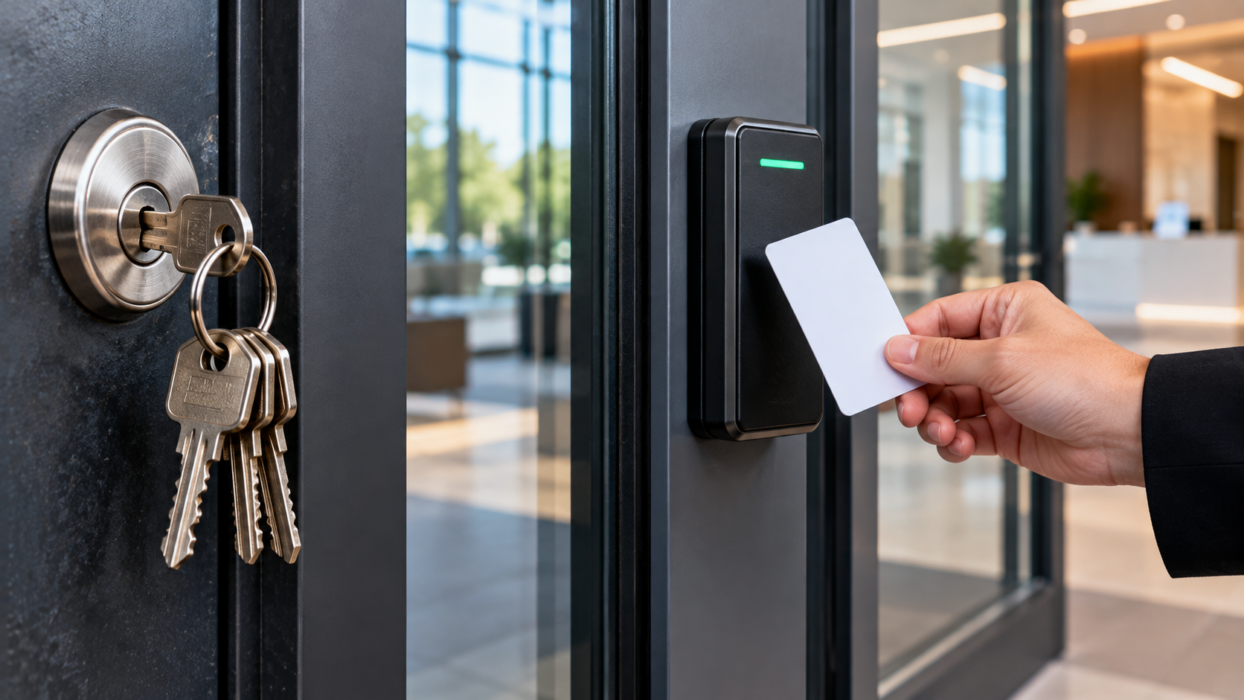
Facility Management, Security Solutions October 6, 2026 Access Control vs. Traditional Keys: A Smarter Approach to Facility Security For decades, metal keys have been the standard way to control access to commercial buildings. They are familiar, relatively inexpensive upfront, and easy to distribute. But managing keys becomes more complicated as an organization grows. Employees leave. Contractors need temporary access. Keys are lost or copied. Facilities add new locations. Sensitive areas require different levels of authorization. Eventually, what started as a simple key-and-lock system can become difficult to manage—and even harder to monitor. Electronic access control provides another approach. Badges, fobs, mobile credentials, and other electronic access technologies allow facility and security teams to manage who can enter specific areas, when they can enter, and what happens when permissions need to change. For organizations evaluating their physical security strategy, here is how traditional keys and electronic access control compare across three important areas: cost, control, and security. 1. Cost: Upfront Expense vs. Long-Term Management Traditional Keys: Simple Until Something Changes Mechanical locks typically have a lower initial cost than an electronic access control system. The challenge comes later. When a key is lost, copied, stolen, or not returned, facility teams may need to determine whether the affected lock—or potentially several locks—should be rekeyed. That can involve: Locksmith service calls Rekeying doors or lock groups Replacing keys for authorized employees Updating master-key systems Coordinating access during the transition Administrative time spent tracking and redistributing keys The larger the facility or organization, the more difficult key management can become. There is another limitation: you cannot simply deactivate a metal key. Once it leaves your control, determining where it is—or how many copies exist—can be difficult. Access Control: Greater Investment, Greater Flexibility Electronic access control generally requires a higher upfront investment because the system may include readers, controllers, electronic locking hardware, credentials, software, networking, and professional installation. The advantage is what happens after installation. If an employee loses a badge or leaves the organization, the credential can typically be disabled without changing the physical lock. Facility teams can also: Add and remove users Modify permissions Issue temporary credentials Manage access schedules Update multiple doors or locations through a centralized system For organizations with frequent personnel changes or multiple facilities, that flexibility can simplify day-to-day access management. 2. Control: Who Can Go Where—and When? Keys Control Possession A traditional key primarily answers one question: Does this person have the key? If the answer is yes, that individual can generally open the corresponding lock whenever they have physical access to it. That can make it difficult to accommodate situations where someone needs access to a space only during certain hours or for a limited period. Electronic Access Controls Permission Electronic access control changes the model from possession to permission. Depending on the system, administrators can establish access based on: Employee or department Job responsibilities Building or location Specific doors Days of the week Time of day Temporary assignments Contractor or vendor schedules For example, a vendor may be permitted to enter a mechanical area from 8:00 a.m. to 5:00 p.m. during a project without receiving the same access as a full-time facility employee. Likewise, employees can receive access to the areas required for their responsibilities without automatically receiving access to IT rooms, records storage, equipment areas, or other restricted spaces. This supports the broader security principle of least privilege: providing people with the access they need without unnecessarily expanding that access. 3. Security: From Limited Visibility to Greater Accountability Traditional Keys Provide Little Information After Entry One of the biggest limitations of a mechanical lock is what it cannot tell you. If a door is opened with the correct key, the lock itself typically does not identify: Who used the key When the door was accessed How often the space was entered Whether the key was being used by its intended holder If an incident occurs, that lack of information can make an investigation more difficult. Access Control Can Create an Activity Record Electronic access control systems can provide credential and door activity that gives security and facility teams greater visibility into building access. Depending on system configuration, administrators may be able to review information such as: Granted access attempts Denied access attempts Credential activity Door events Dates and times of activity That information can support security investigations, internal reviews, compliance requirements, and general facility management. It also creates greater accountability around sensitive spaces. 4. Credentials Can Be Matched to the Facility Access control does not mean every organization needs the same technology. Modern systems can support different credential options depending on security requirements, operations, and budget. These may include: Access cards Key fobs Mobile credentials PINs Biometric technologies Multi-factor authentication A standard office entrance, for example, may have different security requirements than a server room, pharmacy, financial records area, warehouse, or critical infrastructure space. The objective is not necessarily to install the most complex technology available. It is to select an appropriate level of security for each environment. 5. Access Can Change as Quickly as Your Organization Does Employee turnover is one of the clearest differences between keys and electronic access. With a traditional key system, an employee who leaves the organization may return the key—but facility teams still have limited visibility into whether a copy was made. With an electronic credential, access can typically be revoked as part of the offboarding process. The same flexibility can help organizations manage: New employees Employee transfers Contractors Temporary workers Vendors After-hours cleaning crews Seasonal personnel Instead of changing physical locks whenever access requirements change, administrators can update permissions within the system. For growing and multi-site organizations, this can make access management significantly easier to scale. 6. Access Control Can Be Part of a Larger Security Strategy Access control is most effective when it is not treated as an isolated system. Depending on the facility, access control may work alongside: Video surveillance Intrusion detection Intercom systems Visitor management Network infrastructure Security monitoring Emergency procedures Integrating these systems
Read More
Protect Your Critical Facility: Facility Solutions for Data Centers
-
- In Commercial Roofing Facility Management
Commercial Roofing, Facility Management October 5, 2026 Protect Your Critical Facility: Facility Solutions for Data Centers Data centers are built around one essential priority: reliability. From power and cooling to security and building infrastructure, every system must work together to support continuous operations and protect critical technology. But maintaining a reliable data center goes beyond the equipment inside the facility. The building itself—and the systems that protect and support it—plays an important role in reducing risk, maintaining controlled environments, and preventing unexpected disruptions. At Connect Service Solutions, we help data center operators and facility teams take a proactive approach to facility maintenance and infrastructure. Through our family of specialized companies, we provide nationwide solutions for commercial roofing, HVAC, physical security, paving, construction, solar, and other critical facility needs. Why Facility Maintenance Matters for Data Centers Even a relatively small facility issue can create significant consequences in a mission-critical environment. A roof leak, HVAC failure, drainage problem, security vulnerability, or infrastructure deficiency can threaten sensitive equipment and interfere with normal operations. For data centers, proactive facility maintenance helps identify vulnerabilities before they develop into larger problems. It also gives facility teams greater visibility into asset conditions, maintenance priorities, capital planning, and long-term facility performance. Instead of reacting to failures, facility managers can establish a strategy designed around prevention, preparedness, and reliability. Protecting the Building Envelope The commercial roofing system is one of a data center’s first lines of defense against weather and water intrusion. A roof leak that might be considered a routine maintenance issue in another commercial property can carry much greater risk in a data center. Water intrusion can threaten electrical systems, servers, cooling equipment, and other valuable infrastructure. Routine commercial roof inspections and preventative maintenance can help identify conditions such as: Damaged or deteriorating roofing membranes Open seams, flashing, and penetrations Ponding water and drainage concerns Damage surrounding rooftop equipment Aging sealants and roofing accessories Storm, wind, and hail damage Areas of potential moisture intrusion Addressing these conditions early can help reduce emergency repairs, extend roof service life, and minimize disruption to critical operations. Managing Complex Rooftop Infrastructure Data center roofs can be particularly complex because of the mechanical and cooling infrastructure required to support the facility. HVAC equipment, piping, penetrations, supports, electrical components, and ongoing service activity can create additional stress on the roofing system. Each penetration or equipment installation must be properly integrated with the roof to maintain watertight performance. Inspections are also important after mechanical work, equipment upgrades, solar installations, or other rooftop activity. Identifying accidental damage early can prevent a minor issue from developing into a costly leak or operational concern. Maintaining Reliable HVAC and Cooling Infrastructure Temperature and humidity control are essential to data center operations. HVAC and cooling systems must operate reliably to help maintain the controlled environment required by servers and other sensitive technology. A proactive HVAC maintenance strategy can help facility teams identify equipment issues before they result in unexpected downtime. Preventative maintenance, system evaluations, equipment replacement, retrofits, and other HVAC services can also support efficiency and long-term system performance. As data centers continue to evolve and equipment loads increase, maintaining dependable mechanical infrastructure becomes an increasingly important part of overall facility planning. Strengthening Physical Security Protecting a data center also means controlling who can access the facility and monitoring critical areas. Physical security solutions such as access control, video surveillance, system integration, network infrastructure, and preventative maintenance can help data center operators maintain greater visibility and control throughout their properties. Regular security assessments can also help identify vulnerabilities, outdated equipment, or gaps between existing technology and current facility requirements. Preparing Facilities for Severe Weather Mission-critical facilities cannot wait until severe weather arrives to begin preparing. Preventative inspections can identify drainage concerns, loose materials, vulnerable roof flashing, pavement deterioration, and other exterior conditions that may become larger problems during severe weather. Following a significant storm, timely facility assessments can help teams identify damage, prioritize repairs, and respond before smaller issues affect operations. For organizations managing multiple data centers across different regions, a coordinated facility strategy can also simplify emergency response and provide greater visibility across the entire portfolio. Smarter Facility Management Across Multiple Locations Managing one mission-critical facility is complex. Managing an entire data center portfolio requires consistency, documentation, reliable service, and strong communication across multiple markets. Connect Service Solutions brings specialized facility services together through a single-source approach. Our nationwide capabilities help organizations coordinate work across locations while maintaining greater consistency in service, reporting, and project management. A proactive facility management strategy can help data center operators: Understand current asset conditions Identify and prioritize maintenance needs Plan future capital improvements Reduce unexpected repairs Standardize service across multiple facilities Improve visibility across their facility portfolio Make informed decisions based on asset performance Supporting the Full Facility Lifecycle Protecting a data center isn’t a one-time project. It requires an ongoing strategy that evolves alongside the facility and its technology. Through the Connect Service Solutions family of companies, data center operators can access services including: Commercial roofing inspections and maintenance Roof leak investigation and emergency repair Roof replacement, restoration, and coatings HVAC service and preventative maintenance HVAC retrofits and equipment replacement Physical security and access control Video surveillance and network solutions Asphalt and concrete paving Facility and construction management Solar and renewable energy solutions Asset management and capital planning Emergency and storm response Nationwide multi-site facility programs Whether you’re maintaining an existing data center, planning an expansion, upgrading infrastructure, or managing facilities across the country, having the right partners in place can help reduce risk and improve long-term facility performance. Protect the Facility Behind Your Critical Infrastructure Data centers are designed with layers of protection, redundancy, and contingency planning. Your facility maintenance strategy should follow the same philosophy. By identifying vulnerabilities early, proactively maintaining critical building systems, and establishing a reliable plan for emergency response, facility teams can reduce unnecessary risk and better protect the infrastructure their operations depend on. Don’t wait for a facility issue to become an operational problem.
Read More